So I’ve been having a problem with my A3 ever since putting on a catless downpipe and getting APR stage II software.
The problem is that the car is burning a lot of oil (1qt every 800 miles or so). I’m getting tons of oil smoke on deceleration, but none that I can see under boost.
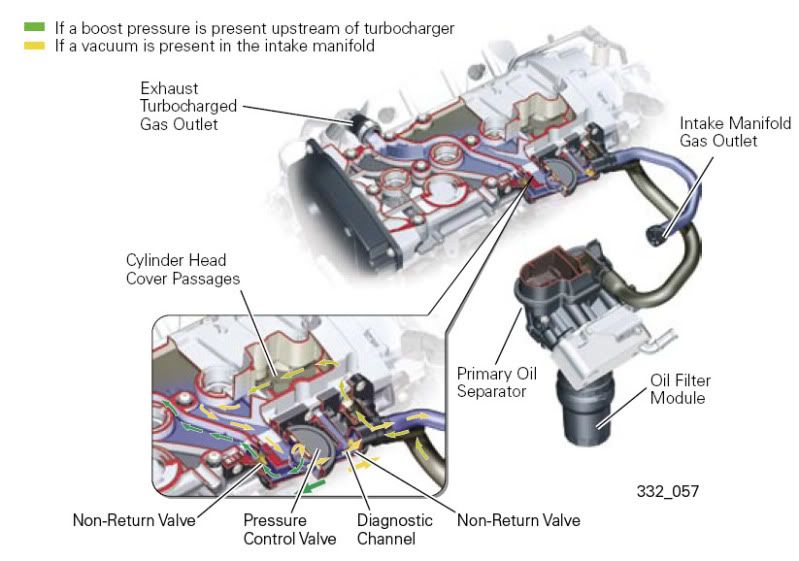
So the logical thing to check on these cars is the PCV system. It routes gasses to the back of the motor under boost (after the maf and before the turbo inlet) and it routes to the front side - intake manifold under vacuum.
Since the PVC system is a weak area on these cars I replaced the front check system and I inspected the back system and found it to be working correctly.
The valve cover on these cars is plastic and has a few channels running through it so I replaced that also since if something was clogged this could be a problem.
This still didn’t fix anything so I did a compression test which came back good (all 190s), and check the plugs which are fine.
The best advice on what to do next is to install a couple catch cans on the front and back to see what collects and hope helps me diagnose.
Could this be the sign of a bad turbo? (but why no noise or smoke under boost?)
at this point I’m very familiar with how the PCV system works on these cars. I don’t like the BSH block off plate because it sends everything to the back port. Think of it this way: If you send oil to the front port it goes to the intake manifold and gets burnt up. If you send it to the back port it will go through the turbo, through the change pipes and inter-cooler and then end up at the intake manifold anyway, so I’m not sure why this is a more desirable path to take. I understand that you can’t send to the front port under boost because the boost pressure would push into the cylinder head from the manifold… but now I’m getting off topic.
here is an interesting thread / solution for those enjoying this topic:
---------- Post added at 12:34 PM ---------- Previous post was at 12:21 PM ----------
I can simulate the BSH block off by plugging the front output and intake manfold with plugs to recreate the BSH solution. I’m just not sure it’s the front port because I’ve just replaced it with a new part that I personally tested before installing.
after exhausting PCV potential problems I found a guy with the exact symptoms who found it was the exhaust side seal in the turbo that was letting oil out. It then vaporizes in the exhaust which is why the smoke looks more white than blue and also explains why it’s only happening at certain conditions.
So I found a great deal on a whole turbo + manifold assembly with only 20k on it so that’s in the mail.
I’m debating if I want to install or pay somebody. If any vendors / mechanics who know they can swap a VW/audi FSI turbo on here want to PM me a quote for turbo swap just send me a PM. I’m guessing it’s 2-3 hours labor?
I inspected / replaced the entire system and nothing was wrong.
After all of this I found a guy in Canada that had the exact same symptoms and in the end discovered that it was the turbo seal leaking oil into the exhaust and then the exhaust vaporized the oil and created the smoke.
So I got a used turbo with 20k for a steal ($320 shipped) and I’m having that installed today by a friend of a friend who has a small shop in rochester.
Carbon build up in the head is annoying, but really not that big of a deal. People seafoam and that appears to help but ultimately it looks like every 50k it’s probably not a bad idea to get them cleaned out. What I’m saying is that in the scheme of things that go wrong and cost money on an audi the carbon build up is not a big deal really.
Seems to really show up on the V6 and V8 FSI motors, even with low mileage. Most of the turbo motors seem to have higher mileages comparably. Never done the seafoam thing myself but thinking about it.
I hear that lexus gets around the problem on their direct inject motors by running another set of injectors (non-direct inject) that fire once and a while to keep the buildup from happening.
Do the BMW Direct Injection motors have the same problem? My car has direct injection too, I’ve been debating whether I should explore the possibility that there is carbon build up.
if you drive a DI motor that has a turbo on it in reverse really fast maybe it will blow all the carbon buildup into the motor and leave it all nice and clean?